The Cardinal Decision Evidence Assessment
A published method for testing whether AI-assisted decisions can be defended after the fact.
Abstract
Regulated firms may be unable to rebuild the AI-assisted decisions they have already made, and few know whether they can, because the question is rarely asked until the decision is being contested. This document sets out an applied test for whether they can.
Six tests examine whether the inputs, system state and human judgement behind a specific past decision were captured, whether that record survives unaltered, whether it persists as long as the firm's liability and whether an outsider could use it. Results resolve through a strict ordered procedure to one of four tiers: Defensible, Partially Defensible, Attested Only and Opaque. The procedure is applied twice, once against the record as it stands today and once against the record that will still exist at the end of the firm's liability horizon, so that a firm which is defensible today and will not be when challenged is reported at both points. What survives to the second assessment is set by a per-component retention schedule, summarised by the Jegede Retention Ratio (R).
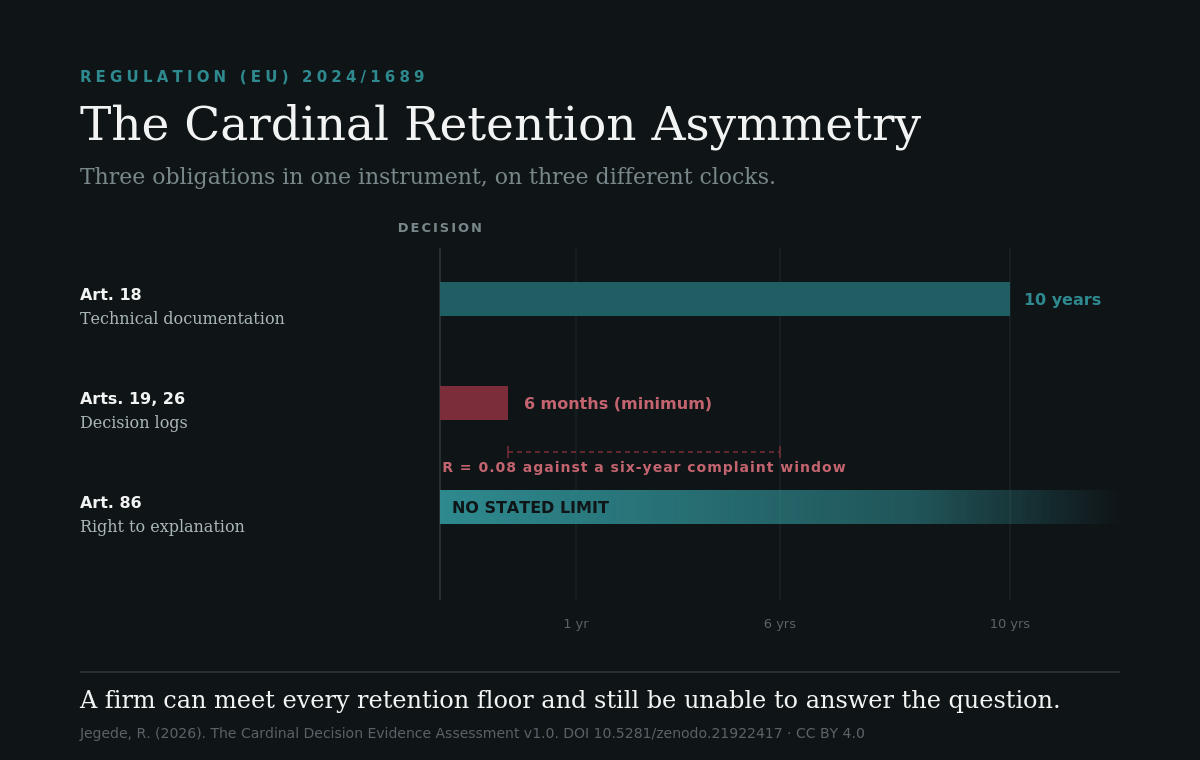
The document also identifies the Cardinal Retention Asymmetry: under Regulation (EU) 2024/1689, technical documentation must be retained for ten years (Art. 18), decision logs for at least six months (Arts. 19, 26) and the right to explanation of an individual decision carries no stated limit (Art. 86). A firm may comply with every retention floor and still be unable to answer the question when it is asked.
The six tests
- Input capture — are the exact inputs retained, or only the output?
- System state — is the state of the system at the point of decision recorded?
- Human intervention — where a person accepted, modified or overrode the output, is that act recorded with its rationale?
- Temporal integrity — can the decision be rebuilt as it stood on the decision date?
- Retention horizon — do the records survive as long as the liability does?
- Third-party rebuild — could a competent outsider perform the rebuild from the record alone?
Versions
Version 1.1 supersedes version 1.0 (DOI: 10.5281/zenodo.21922417, 13 August 2026), which remains permanently available. The classification procedure has changed and results produced under version 1.0 should be re-scored.
Use
This method is published in full and licensed CC BY 4.0. Firms may apply it to themselves without engaging Cardinal AI Systems and without notification.
A self-scored result is a management tool. It tells a firm what it needs to know internally, and for many purposes that is enough.
It is not evidence. A supervisor, an insurer or an acquirer asking whether a firm can reconstruct its AI-assisted decisions will not accept the firm’s own assessment of itself — which is the same objection Test 6 makes about a rebuild performed by the team that built the system. Independence is what converts a score into something a third party can rely on.
Score one decision type
Six questions about a specific past decision, returning both tiers and the Jegede Retention Ratio with its governing component. It runs in your browser and nothing is sent anywhere.
Independent assessment
Cardinal AI Systems applies this method independently to a single decision type: both tiers, the Jegede Retention Ratio with its governing component, and a gap register naming what would have to change to move the tier. Board-ready output. Fixed fee, from £2,500.
The rebuild at Test 6 is performed by someone with no institutional knowledge of the firm, working only from the retained record. That is the part a firm cannot do for itself.
Most firms run more than one decision type. Additional types assessed in the same engagement are charged at a reduced rate, because the second costs materially less than the first.
Cite as
Jegede, R. (2026). The Cardinal Decision Evidence Assessment v1.1. Cardinal AI Systems. DOI: 10.5281/zenodo.21952103